Blog
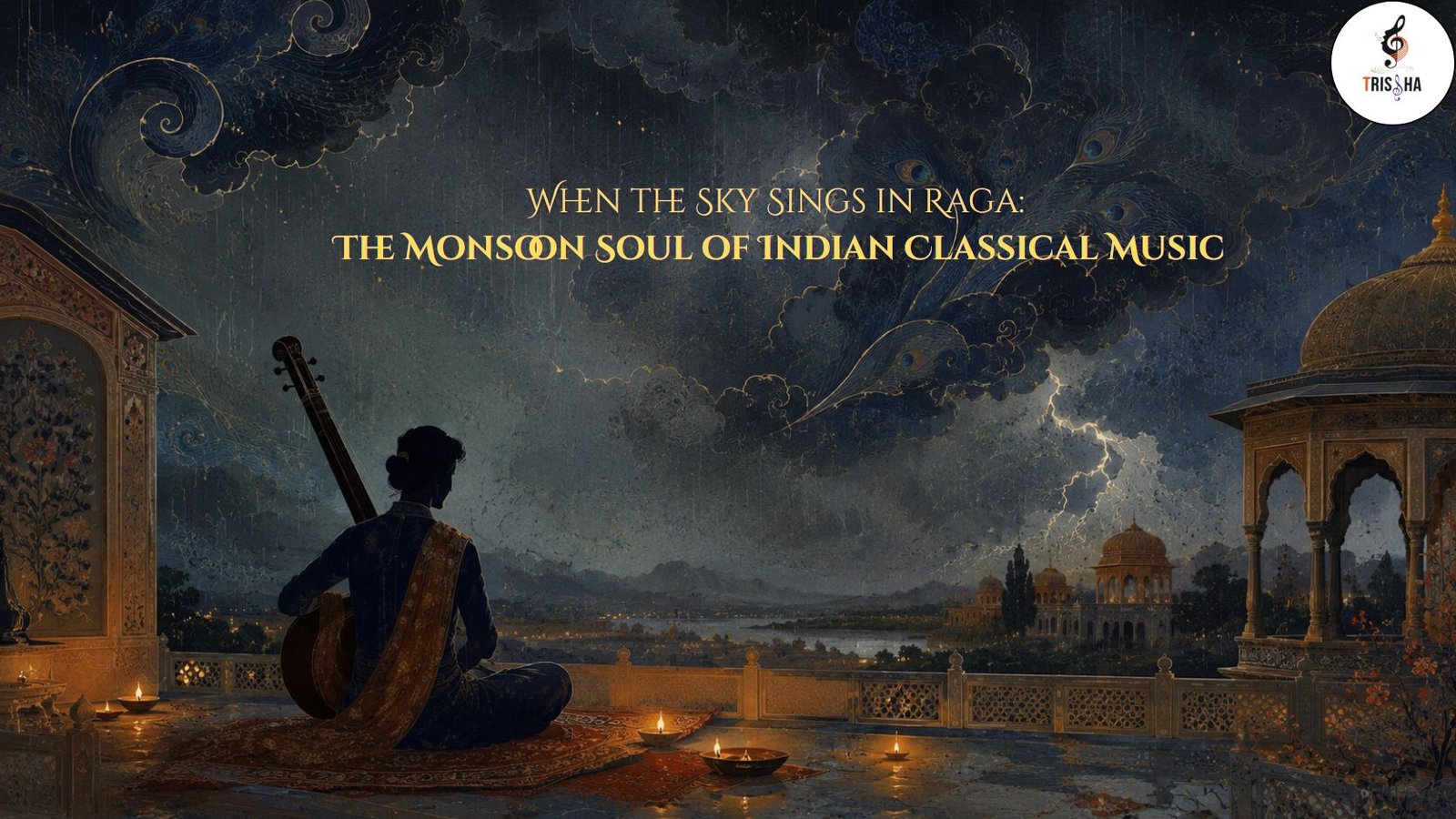
When the Sky Sings in Raga: The Monsoon Soul of Indian Classical Music
There is a particular kind of silence that falls over an Indian city just before the first monsoon shower — the air turns metallic, the crows go quiet, and somewhere, almost involuntarily, a line of an old Malhar composition surfaces in memory. This is not a coincidence. For centuries, Indian classical music has treated the rains not as weather, but as a character — moody, generous, occasionally cruel, always worth singing to.
The Family Called Malhar
At the centre of this tradition sits Malhar, not a single raga but an entire family of them — over thirty variants by most counts, each a slightly different shade of the same monsoon feeling. The word itself is said to derive from Sanskrit roots meaning "remover of impurity," a fitting name for a melody built to summon the rain that washes a parched land clean. Miyan ki Malhar, the most celebrated member of this family, carries the signature of Tansen, the 16th-century court musician of Emperor Akbar, who is credited with shaping it into the form musicians still perform today.
What makes Malhar so distinctive isn't just its mood but its construction. The raga uses both the flat and sharp versions of certain notes — ga and ni — one after another, a technique that creates a rolling, swinging quality often compared to the low rumble of distant thunder. It's less an imitation of rain and more a musical translation of what rain feels like — anticipation, release, relief.
Tansen, Fire, and the Daughter Who Saved Him
No conversation about monsoon ragas survives long without the legend of Raga Deepak. As the story goes, Akbar once asked Tansen to sing this raga — reputed to generate such intense heat that its singer risked being consumed by fire. Tansen, unable to refuse his emperor, quietly trained his daughter Saraswati beforehand in Megh Malhar. As his performance of Deepak set the court ablaze, Saraswati's voice summoned the clouds, and rain doused the flames just in time. Historians are candid that the tale is more myth than documented fact — but its endurance says something important: in Indian classical thought, music was never considered separate from the natural world. It was believed capable of provoking it.
That belief wasn't confined to legend. In 1948, when drought struck Surat, the noted Gwalior gharana vocalist Pandit Omkarnath Thakur was invited to sing for rain. Three days into his recital, it reportedly drizzled. He credited the farmers' prayers, not his voice — but the story has stayed alive precisely because it fits so naturally into a musical culture that never fully separated art from invocation.
Krishna, Longing, and the Poetry of Waiting
Beyond thunder and cloudburst, Malhar carries a quieter theme — longing. Krishna, whose name literally means "dark," is often depicted as the human echo of the monsoon cloud itself, and countless compositions in this raga family speak of a lover waiting for their beloved's return, the way farmers once waited for travellers to come home before the rains closed the roads. This is also the world of Kalidasa's Meghaduta, where an exiled yaksha sends a message to his wife via a passing cloud — proof that the rain-as-messenger idea runs far deeper into Indian literature than music alone.
Why It Still Matters
You don't need to know a single note of Hindustani classical music to feel why Malhar endures. It's built on something almost universal — the ache of heat finally breaking, the smell of the first rain on dry earth, the strange mix of joy and melancholy that monsoon carries in a subcontinent shaped by it. Ragamala paintings captured it in miniature. Kajris and jhoolas carried it into folk song. And centuries later, when a vocalist opens their throat into Miyan ki Malhar just as the first drops hit a tin roof, it still feels less like performance and more like conversation — between a musician and the sky.