Blog
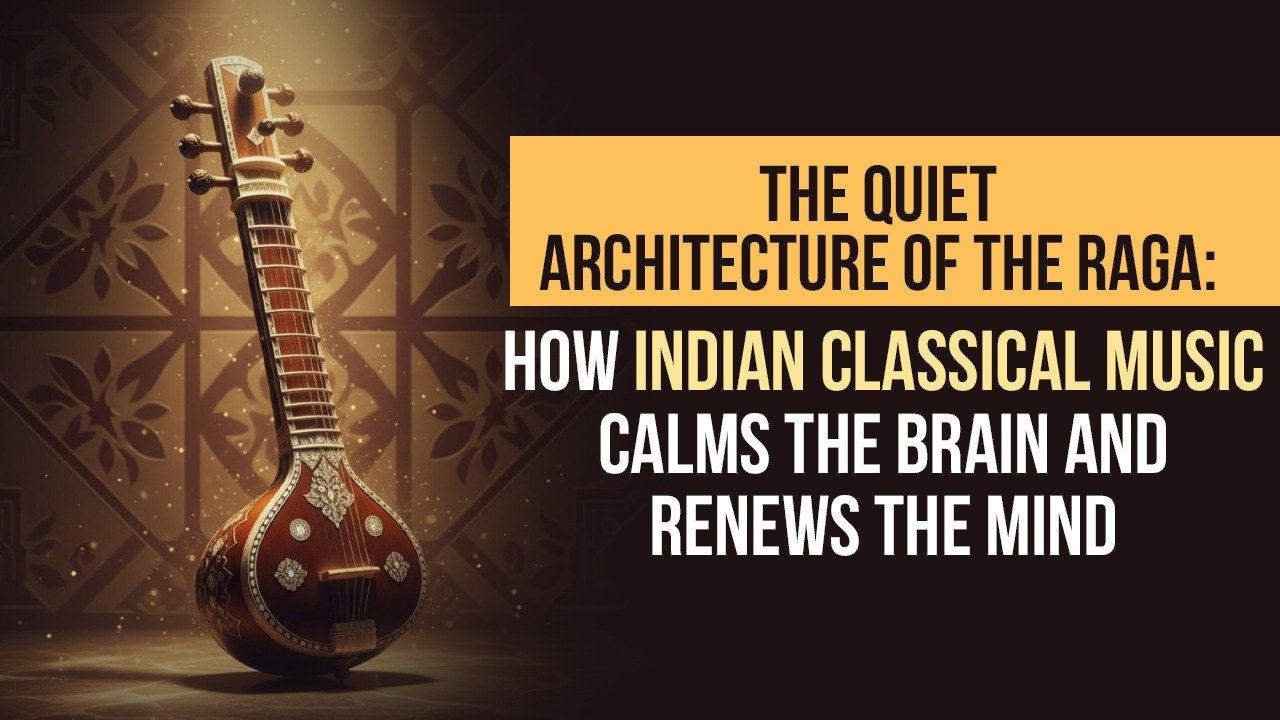
The Quiet Architecture of the Raga: How Indian Classical Music Calms the Brain and Renews the Mind
There is a particular stillness that settles over a room when a sitar begins to unfold a raga, or when a vocalist holds a single note and lets it bloom. It feels almost medicinal. As it turns out, that impression is not merely romantic sentiment. A growing body of neuroscience now suggests that Indian classical music engages the brain in ways that genuinely quiet the nervous system and refresh the mind.
A Tradition Built on Structure and Emotion
Indian classical music is organised around three foundational elements: the raga (a melodic framework), the tala (a rhythmic cycle), and the swara (the individual musical notes). Together these create an intricate, almost mathematical system. A raga is far more than a scale. It is a defined arrangement of pitches, characteristic phrases, permissible ornamentations, and a governing aesthetic mood, or rasa. Many ragas are traditionally tied to particular times of day or seasons, lending them a ritualised temporal rhythm that mirrors the body's own cycles.
This structure matters because the brain responds to it in measurable, distinctive ways. Unlike music that aims for a general emotional lift, a raga is designed to evoke specific emotional states through its particular ordering of notes, and these effects are believed to intensify when a raga is performed at the time of day to which it traditionally belongs.
What the Brain Actually Does
The clearest evidence comes from studies of brainwave activity recorded through electroencephalography, or EEG. A meta-analysis published in 2023, drawing together prospective studies from the previous decade, examined the effect of ragas on the brains of healthy listeners. Across 71 participants aged between 19 and 30, the researchers found that listening to Indian classical music produced statistically significant increases in alpha activity and in attention scores.
That finding is significant. Alpha waves are associated with a state of relaxed alertness: the calm, wakeful condition we experience when the mind is at ease but not drowsy. An increase in alpha activity is, in effect, a neural signature of a settled mind. The same analysis noted that ragas appear to stimulate arousal in different regions of the brain depending on the emotions a given raga is intended to evoke, suggesting that the music's effect is targeted rather than diffuse.
Other research has explored how the components of the music engage the brain in concert. The melodic raga resonates with circuits in the auditory and limbic regions, areas closely tied to emotional processing. The rhythmic tala engages the motor and auditory cortices, supporting a kind of sensorimotor synchronisation. The individual swaras, with their precise frequency relationships, are thought to encourage neural entrainment, in which the brain's natural oscillations begin to align with the patterns of the music. The result is a coordinated neural response that draws perception, emotion, and rhythm into a single flow.
Why It Soothes Rather Than Stimulates
Part of the calming power lies in what music does to brain chemistry more broadly. Listening to music can prompt the release of neurotransmitters associated with pleasure and well-being, help regulate mood, and even reduce the perception of pain. Because so many different regions of the brain participate in processing music, listening also keeps neurons and synapses active, offering a gentle form of mental exercise that feels effortless.
Indian classical music seems especially suited to this soothing effect. Its slow, unhurried introductions, known as the alap, invite the listener into a meditative pace before any rhythm enters. The repetition and gradual development within a raga give the mind something to settle into rather than chase. There is space in the music, and the brain appears to use that space to slow down.
A Practice Worth Keeping
None of this requires formal training or deep familiarity with the tradition. The research consistently studied ordinary listeners, not seasoned musicians. Setting aside even fifteen or twenty minutes to listen attentively, ideally to a raga associated with the relevant time of day, may be enough to shift the brain toward that relaxed, alpha-rich state.
In an age of constant stimulation, the value of music that asks us to slow down and simply listen is hard to overstate. Indian classical music offers more than cultural richness or aesthetic pleasure, though it offers both abundantly. It offers a quiet, evidence-supported pathway to a calmer brain and a clearer mind, an ancient architecture of sound that the modern study of the brain is only beginning to fully appreciate.