Blog
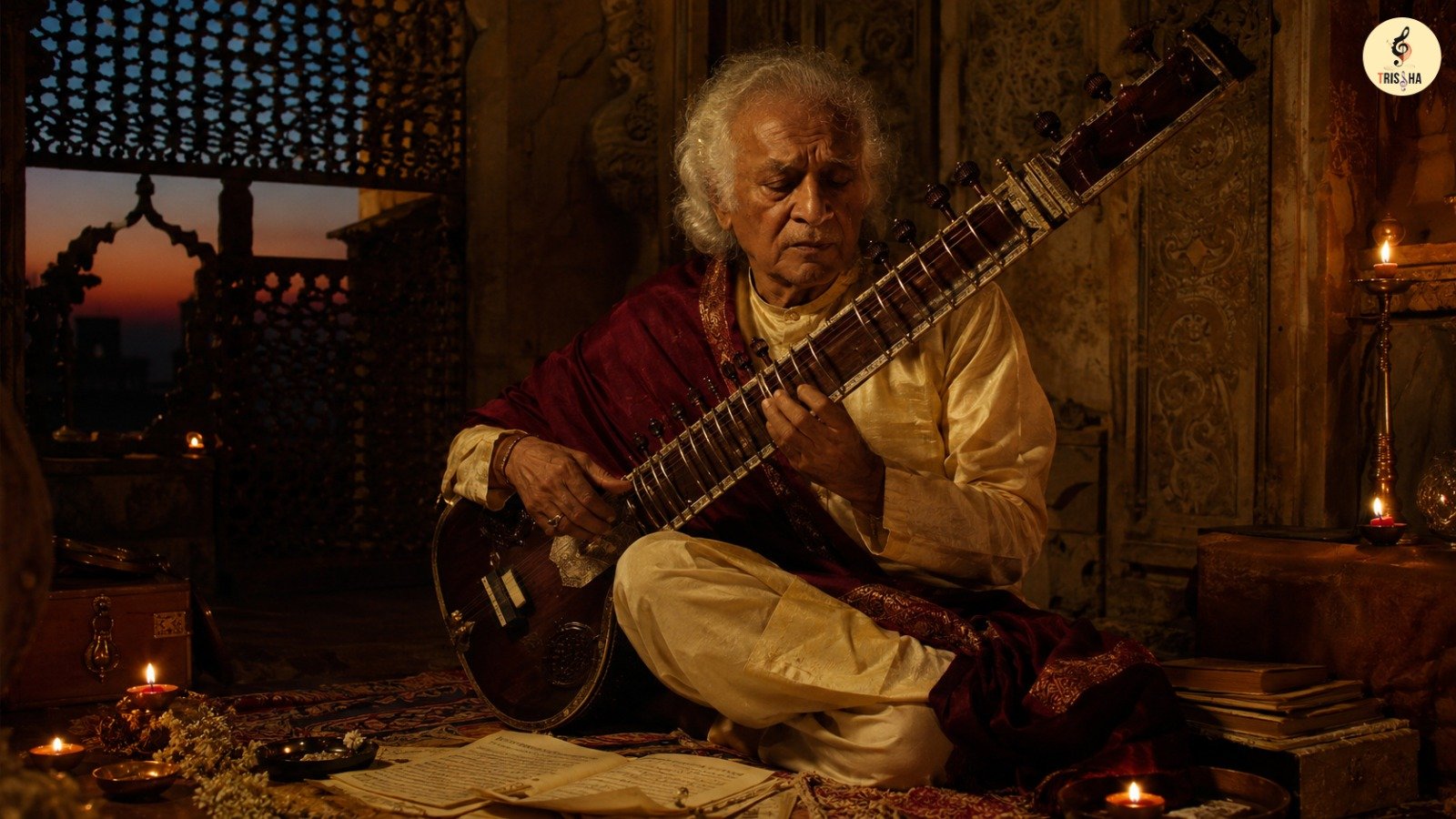
The Living Grammar of Indian Classical Music
How an ancient oral tradition endures — and evolves — in the age of streaming and global stages
There is a particular kind of silence that precedes an Indian classical concert. It is not the hushed expectancy of a Western recital hall, where the raising of a conductor's baton signals the start of something fixed and final. It is, rather, a silence laden with possibility — an understanding shared between performer and audience that what is about to unfold has never happened before and will never happen again. In this unrepeatable quality lies the most extraordinary characteristic of Indian classical music: it is a tradition that is simultaneously ancient and in perpetual motion.
To speak of Indian classical music as a single entity is, of course, already a simplification. The subcontinent carries within it two great and distinct classical traditions — Hindustani, flourishing across North India, and Carnatic, which governs the musical life of the South — each with its own repertoire, aesthetic philosophy, and generational lineages. Together, they represent one of the most sophisticated and unbroken systems of musical thought on earth, stretching back over two and a half millennia to the treatises of the Vedic period.
"The raga is not a scale. It is a personality — a time of day, a mood, an emotional archetype — and the musician's life work is to know it, deeply and wholly, before daring to speak through it."
The Architecture of Raga
At the heart of both traditions is the concept of the raga — a word that derives from the Sanskrit root meaning "to colour" or "to illuminate." A raga is, at its most elemental, a melodic framework: a prescribed set of notes, characteristic phrases, ornamental gestures, and emotional associations. But this description, though accurate, utterly fails to convey the lived experience of the form. A raga is not a scale any more than a human being is a skeleton. It is a personality.
Each raga is assigned to a particular time of day or season. Bhairav is a raga of dawn, its austere intervals carrying the quality of early morning mist and solitude. Yaman, built on the elevated fourth of the Kalyan thaat, belongs to the first quarter of the night and carries a mood of romantic longing and serene beauty. Darbari Kanada is performed deep into the evening, its slow, meditative meend (slides between notes) evoking a gravity bordering on the sublime. To perform a raga at the wrong hour is not merely a convention violated — it is, within the aesthetic universe of this music, a kind of discordance, a misalignment with the natural order.
This is a system that demands extraordinary patience of its practitioners. A student of Hindustani classical music may spend the first several years of formal instruction mastering a single raga — learning not only its notes but its characteristic moods, its forbidden intervals, its relationship to the ragas that surround it, and the subtle physical adjustments of the voice or instrument that allow one to inhabit, rather than merely perform, the form.
The Guru-Shishya Parampara and the Question of Continuity
Living tradition
Perhaps no aspect of Indian classical music is more philosophically rich — or, in contemporary terms, more fragilely placed — than the institution of the guru-shishya parampara: the lineage of transmission from master to disciple. Knowledge in this tradition has historically been non-textual. It is passed from a teacher's hands to a student's ears across years of proximity, repetition, and intimate correction. The written treatise, the recorded album, the transcribed score — these are aids at best. The living knowledge lives in the body.
The great gharanas (schools or houses) of Hindustani music — Gwalior, Jaipur-Atrauli, Kirana, Agra, Patiala — each developed their own interpretive temperaments over generations, shaped by geography, patronage, and the individual genius of their founding figures. The Gwalior gharana is credited with formulating much of the modern khayal framework; the Kirana gharana, associated with the legendary Abdul Karim Khan and later Bhimsen Joshi, is known for its deeply spiritual, sustain-heavy vocal approach. These are not merely stylistic differences. They are, in a meaningful sense, different philosophies of what music is for.
Raga
A melodic framework with prescribed notes, phrases, and emotional identity — assigned to specific times of day or season.
Tala
The rhythmic cycle governing a composition — ranging from the three-beat Tisra to the complex 108-beat Dhammar.
Gharana
A hereditary school of music, each with a distinct interpretive philosophy passed through generations of masters and disciples.
Alap
The opening, unaccompanied section of a classical performance — a slow, raga-revealing meditation conducted entirely without rhythm.
Tala: The Mathematics of Time
If raga governs melody, tala governs time. The rhythmic architecture of Indian classical music is, in the estimation of many musicologists, among the most sophisticated ever developed. Talas are not simply time signatures in the Western sense; they are cyclical structures of varying lengths — the ubiquitous Teentaal has sixteen beats, arranged in four groups of four, whilst Jhaptaal runs to ten, grouped five-two-three — and the relationship between the melodic performer and the rhythmic accompaniment constitutes a form of real-time dialogue, a conversation conducted at speed through highly codified gestures and counter-gestures.
The tabla, the paired hand-drums that dominate Hindustani percussion, is itself an instrument of extraordinary depth. A trained tabla player does not simply keep time; they construct a parallel musical argument. The bols — the syllables used to vocalise and memorise tabla compositions — have their own literature, and a tabla solo (or solo gat) performed in the latter portion of a concert can run to twenty or thirty minutes of sustained rhythmic elaboration.
The Carnatic Contrast
The Carnatic tradition of South India differs from its northern counterpart in ways that are as revealing as they are profound. Whilst Hindustani music was shaped over centuries by Persian and Mughal court influences — absorbing the khayal form, the plucked sitar, and new conceptions of ornamentation in the process — Carnatic music underwent no such external intervention. It remained, in large part, a devotional art, deeply rooted in the Bhakti movement and the compositions of the Trinity: Tyagaraja, Muthuswami Dikshitar, and Syama Sastri, all of whom lived and worked in the late eighteenth and early nineteenth centuries in present-day Tamil Nadu and Andhra Pradesh.
These three composers between them produced thousands of compositions — kriti, varnam, and pada — that remain the bedrock of the Carnatic concert repertoire today. Tyagaraja alone is credited with over seven hundred kritis in Telugu and Sanskrit. A concert programme in Chennai's world-famous December Season, which has run continuously since 1927, may include works spanning twelve centuries of Carnatic composition, alongside raga alapana, niraval (melodic improvisation within a composition's lines), and the exhilarating kalpanaswara passages — rapid, rhythmically intricate improvised sequences built on solfège syllables.
The Question of the Modern Moment
No honest account of Indian classical music in 2026 can ignore the challenges — and the opportunities — of the present moment. The institutional architecture that once sustained these traditions has changed beyond recognition. Royal patronage collapsed with the princely states in 1947. The All India Radio system, which for decades served as a crucial mechanism for disseminating and sustaining classical artists, has diminished in cultural authority. And the demographic reality is pressing: classical training demands a commitment that sits uneasily alongside the pace and priorities of contemporary urban life.
And yet the tradition not only persists; in certain respects, it flourishes. The rise of global streaming has brought the recordings of Pandit Ravi Shankar, M.S. Subbulakshmi, Bismillah Khan, and Gangubai Hangal to listeners who have never set foot in India. A new generation of practitioners — many trained in the old manner but thoroughly conversant with digital tools — are finding audiences on YouTube, performing fusion collaborations that would have been unthinkable a generation ago, and simultaneously recording some of the most orthodox and rigorous classical performances of any era.
The tension between purity and evolution is, of course, not new. Every generation of classical musicians has navigated it. Ustad Alauddin Khan, the founder of the Maihar gharana and teacher of both Ravi Shankar and Ali Akbar Khan, was himself a radical synthesiser — a man who absorbed influences from across the subcontinent and beyond and forged from them a new musical voice of towering authority. The tradition has always grown by engaging with the world around it, whilst maintaining the discipline and rigour that give it meaning.
Why This Music Matters
To listen carefully to Indian classical music — and it does require careful listening, particularly at first — is to encounter a conception of time that is fundamentally different from that which governs most contemporary experience. A classical performance does not hurry. An alap in the morning raga Bhairav may unfold for forty minutes before a single rhythmic beat is heard; the musician is not building towards something — they are inhabiting something. The music asks its listener to slow down, to relinquish the habit of anticipation, and to find richness in the immediate moment.
In this sense, perhaps, Indian classical music offers something that goes beyond the aesthetic. It is a practice of attention — a centuries-old technology for cultivating presence, for discovering that the interval between two notes, dwelt upon at sufficient depth, contains a universe. That such a practice has survived into the twenty-first century is remarkable. That it continues to produce musicians of genius — that the alap of a young vocalist in Varanasi or the violin of a prodigy in Thiruvananthapuram still has the power to stop time — is something very close to a miracle.