Blog
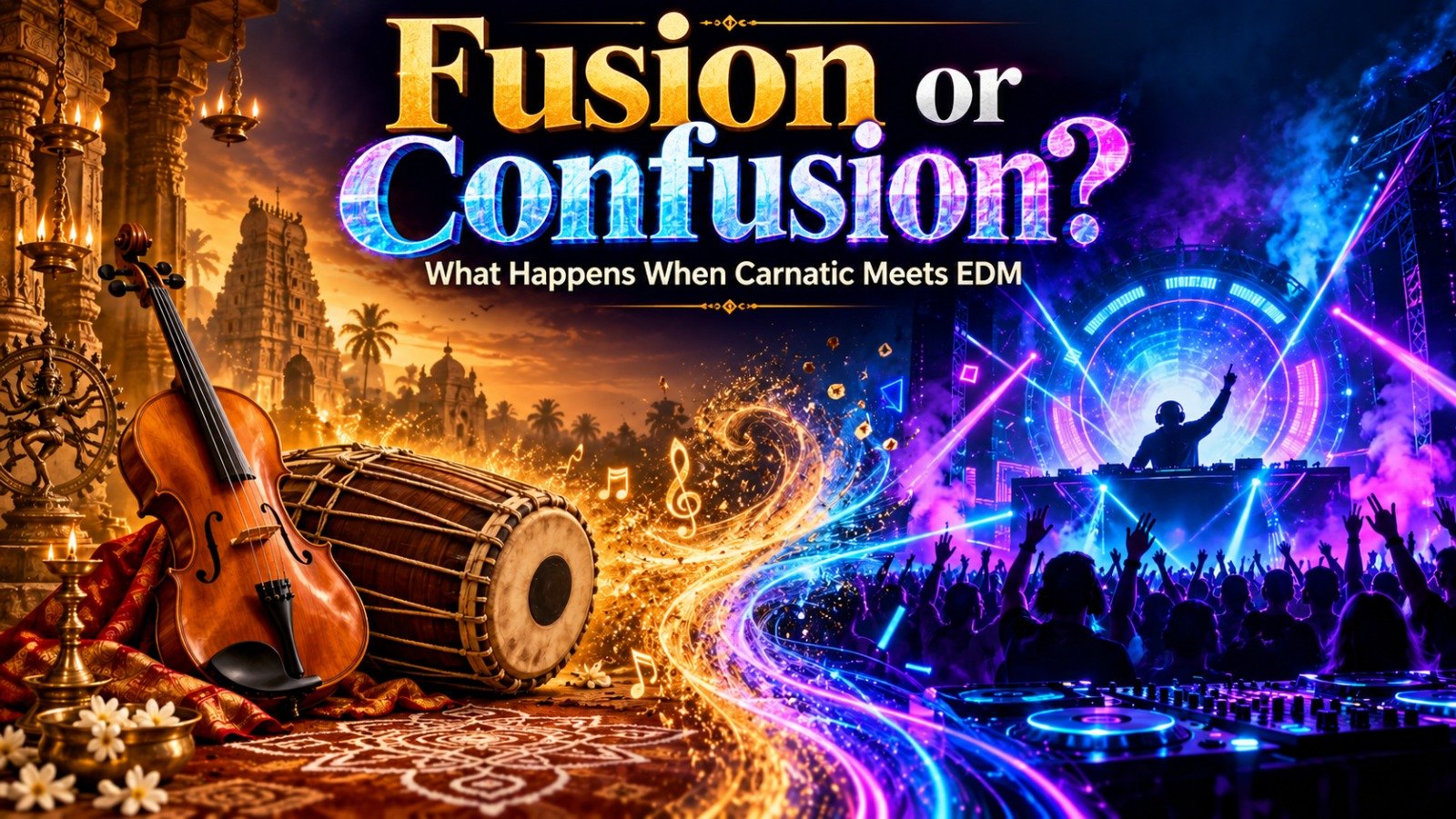
Fusion or Confusion? What Happens When Carnatic Meets EDM
Walk into any music festival in Bangalore or Chennai today, and you might hear something strange. A mridangam beat locks into a four-on-the-floor kick drum. A violinist glides through a raga while a synth pad hums underneath. Somewhere in the mix, a vocalist holds a gamaka that would make a purist smile, right before the bass drops.
This is Carnatic-EDM fusion, and it is one of the most talked-about trends in Indian music right now. But the question on everyone's mind remains the same: is this genuine fusion, or is it just confusion dressed up as innovation?
The Rise of Carnatic-EDM Fusion Music
Carnatic music is one of the oldest classical traditions in the world, built on strict rules of raga (melody) and tala (rhythm). EDM, or electronic dance music, is almost its opposite. It is built on repetition, drops, and digital production rather than centuries of oral tradition.
So why are artists mixing them at all?
Part of the answer is audience hunger. Young Indian listeners grew up with both worlds. They attended Carnatic kutcheris with their grandparents and danced to Avicii and Martin Garrix at college fests. Artists like Karthick Iyer, Sid Sriram, and bands such as Agam and Thaikkudam Bridge have spent years proving that a violin solo and a synth lead can share the same stage without either one losing its identity.
Streaming platforms have amplified this further. Playlists titled "Indian Fusion" or "Desi Electronic" now sit comfortably next to Bollywood and Carnatic classical categories, and they are getting real traction.
Where the Fusion Actually Works
When done well, Carnatic-EDM fusion respects both traditions instead of flattening them.
Good fusion producers do not just slap a beat under a raga and call it a day. They study the mathematical complexity of talas like Adi or Rupaka and find ways to translate that rhythmic intelligence into electronic patterns. They let the gamakas, those signature oscillations and slides in Carnatic vocals, breathe instead of auto-tuning them into a generic pop shape.
Artists who succeed usually have training in both worlds. A producer who understands the emotional weight of raga Kalyani will handle it very differently than one who is simply chasing a viral sound. That difference shows up instantly to listeners who know the tradition.
Where It Turns Into Confusion
Not every attempt lands. Some tracks lean so heavily on Western production tricks that the Carnatic element becomes decoration rather than substance. A raga gets sampled for eight seconds, looped, and buried under a wall of bass, with none of its actual structure or intent preserved.
This is where critics push back, and fairly so. Carnatic music carries deep spiritual and cultural weight. When it gets reduced to a texture or a hook without understanding, it can feel less like homage and more like extraction. Purists worry that younger audiences will only ever hear the surface of the tradition, never its depth.
The line between fusion and confusion often comes down to intent and craftsmanship. Does the artist understand what they are borrowing? Are they collaborating with trained Carnatic musicians, or simply sampling from a stock library?
The Verdict: Fusion Done Right Is a Bridge, Not a Blur
The honest answer is that both things are happening at once. Some Carnatic-EDM fusion is genuinely groundbreaking, expanding what Indian classical music can sound like in a modern context and introducing it to listeners who might never have sought it out otherwise. Other examples are shallow, chasing trends without respect for the source.
The best fusion artists treat Carnatic music as a collaborator, not a sample pack. They bring in trained vocalists and instrumentalists, they credit the tradition properly, and they let both genres retain their own character even while sharing a track.
For listeners, the way forward is simple: seek out the artists who clearly know both worlds deeply. For artists, the challenge is to keep pushing boundaries without losing the soul of what makes Carnatic music so powerful in the first place.
Fusion or confusion? It depends entirely on who is holding the mixing board, and whether they came to learn or just to borrow.